Peptide Purity & Quantitation Testing
Recognizing Peptide Pureness Testing
These can be specifically problematic because their chromatographic actions is really similar to the target peptide, making them harder to separate during purification. When a peptide is 98% pure, that staying 2% isn't arbitrary sound-- it's specific, recognizable kinds of by-products. Mass spectrometry determines the molecular weight of a substance with extreme precision. For peptides, one of the most common techniques are electrospray ionization (ESI-MS) and matrix-assisted laser desorption/ionization time-of-flight (MALDI-TOF). HPLC divides a blend right into its private elements based on exactly how each molecule connects with a specially created column.- Pureness varies commonly, from 40% to 80%+ depending on series size and difficulty.
- HPLC informs you what percentage of your sample is the major substance-- but it does not confirm what that primary substance really is.
- Tests can be performed utilizing high-precision stablizing chambers, replicating different atmospheres, and using global standards to examine short-term and long-term stability, critical for constant peptide performance.
Peptide Applications In Useful Foods And Health Items
Not every application demands 99% purity, and purification is a considerable component of peptide production cost. Trace amounts of solvents utilized throughout synthesis and filtration-- acetonitrile, dimethylformamide (DMF), dichloromethane-- can remain in the final product. These are generally existing at very reduced degrees in effectively manufactured peptides and are governed by ICH Q3C guidelines for acceptable limits. If the target peptide's height make up 99.1% of the total optimal area, the peptide is reported as 99.1% pure by HPLC. Many reliable study peptide providers utilize third-party laboratories; some conduct internal testing with publication of laboratory qualifications.
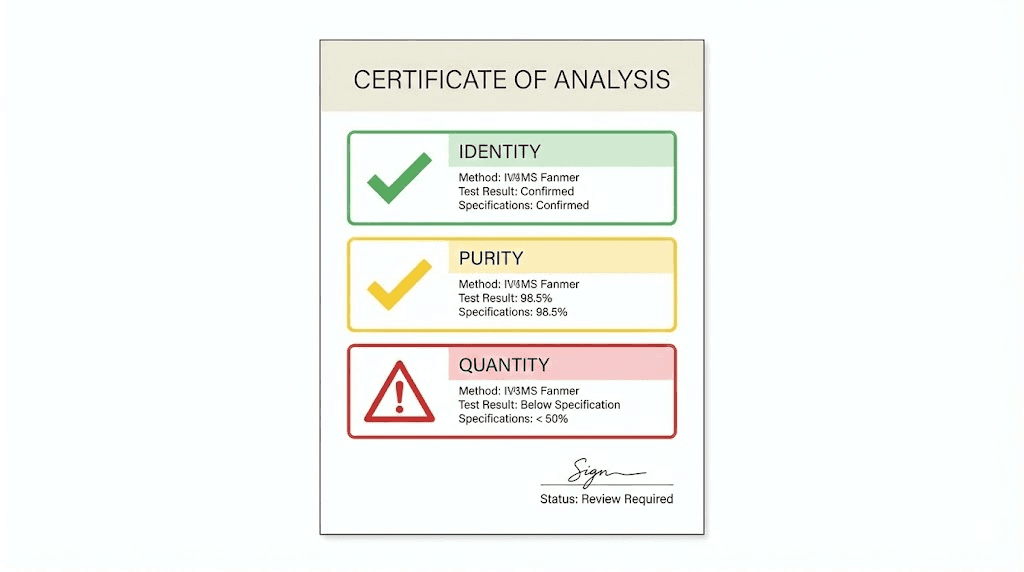
These alterations transform the peptide's organic task and chromatographic account. Peptides are delicate to temperature level, light, and chemical environments, making them vulnerable to degradation, which impacts efficiency. BOC Sciences offers accelerated stability, light stability, and enzymatic deterioration experiments to systematically analyze formula security threats.Creative Peptides proposes a collection of various pureness degrees to assist you select the ideal peptide pureness for peptide-based assays and applications. The following checklist shows the advised peptide purity degrees required for numerous peptide applications. Peptide identification is mostly performed using mass spectrometry (MS), which offers exact measurements of peptide molecular weight. In addition, methods such as amino acid evaluation and HPLC are used to verify the peptide's identification and pureness, ensuring precise characterization for numerous applications. We supply peptide identification confirmation making use of mass-based methods picked for the example and analytical function. This is essential when the main question is whether the observed component matches the desired peptide or whether a modification has actually been included as expected.
Deamidation Items
Examinations can be carried out using high-precision stablizing chambers, mimicing different environments, and applying global requirements to research temporary and long-term stability, vital for regular peptide performance. Some peptides stop working not due to the fact that the sequence is wrong, but since their physical habits in real solvents is badly comprehended. Cold Storage We supply physical property testing that assists teams work better with tough samples. Mass spectrometry validates whether the gauged mass matches the anticipated peptide mass. The chromatogram is the most vital aesthetic data element on an HPLC peptide test record. It is a chart with time on the horizontal axis and detector reaction, generally UV absorbance, on the vertical axis.
In theory, peptide purity is quantified by the chromatogram created by reversed stage HPLC, and furthermore, we can acquire the number and loved one quantity of feasible byproducts by computing the peak location. A high-quality chromatogram has a solitary, in proportion major optimal Amino Acid Chains with a flat standard on either side. " Tailing"-- where the top trails off slowly on one side-- can indicate column issues, sample overloading, or additional interactions in between the peptide and the fixed phase. In this arrangement, the stationary stage is hydrophobic (water-repelling), typically C18-bonded silica. The mobile stage is a slope of water and an organic solvent like acetonitrile, usually with a small amount of trifluoroacetic acid (TFA) to sharpen the optimals.If you've ever before searched a peptide magazine, you've seen pureness numbers anywhere. These numbers obtain thrown around so often that it's very easy to gloss over them-- simply one more specification on an item web page. Chameleon Peptides sells research compounds specifically for laboratory and logical purposes. All PRG items are meant solely for artificial insemination study or additional production use. Making use of a very cleansed peptide lowers these risks and enhances the integrity of your data.
The friend page on why 99 percent pureness matters describes why little pollutant percentages can still matter in delicate in-vitro assays. Together with this peptide screening overview, those pages create the trust-methodology layer behind the product directory. Peptide screening is powerful, but researchers must check out the range of each technique thoroughly.